
FAQs
What is so special about The Bitless Bridle and how does it work?
What are the benefits of using The Bitless Bridle?
Is it safe to ride a horse without a bit in its mouth?
Why does a bit interfere with a horse’s breathing?
Why does a bit interfere with striding?
Does one have to use different aids when using The Bitless Bridle?
Can the BitlessBridle be used for neck reining?
Does the horse need special training to become accustomed to The Bitless Bridle?
Can The Bitless Bridle be used on all types of horses and in all disciplines?
Is The Bitless Bridle suitable for starting a two-year-old, or is it only for fully-schooled horses?
Under riding school conditions, can The Bitlesss Bridle be used by a novice rider?
Is there any way to get around competition regulations that require the use of a bit?
Can The Bitless Bridle be used at the racetrack for training or for racing?
Can The Bitless Bridle be used for driving?
Might The Bitlesss Bridle be of help in alleviating or eliminating the problem of headshaking?
Can I use a martingale with The Bitless Bridle?
How can I obtain The Bitless Bridle?
Will I be able to ride with close contact when riding Dressage and Hunt Seat?
Do they come in different sizes, colors and materials?
Where can I find more information?
| What is so special about The Bitless Bridle and how does it work? |
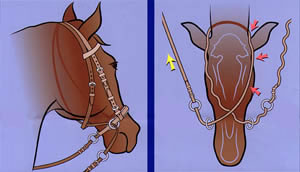
view from the side, view from below.
The Bitless Bridle works on an entirely different concept from all other types of bridles. A bitted bridle enables the rider to communicate by applying pressure on the exquisitely sensitive mouth. The traditional bitless bridles (i.e., the Hackamores, bosals and sidepulls) work primarily through pressure on the nose. All these methods, the bit method and the traditional bitless methods, are potentially painful. The Bitless Bridle, on the other hand, allows the rider to communicate by painless pressure that is distributed around the whole of the head. Whereas a bit often applies harsh pressure to the mouth, over a small area, The Bitless Bridle distributes its gentle pressure to far less sensitive tissues and distributes even this amount of pressure over a wide area. It does this through two loops, one over the poll and one over the nose. Essentially, it gives the rider an inoffensive and benevolent method of communication by applying a nudge to one half of the head (for steering) or a hug to the whole of the head (for stopping). Because The Bitless Bridle exerts minimal pressure and spreads this over a large and less critical area, it is more humane than a bit. It provides better communication, promotes a true partnership between horse and rider, and does not interfere with either breathing or striding. As a result, performance is improved.
What are the benefits of using The Bitless Bridle?
KINDER CONTROL: No more metal in the mouth. Man has been controlling the horse by applying pressure in one of the most sensitive parts of the horse’s body. ‘Natural Horse-Man-Ship’, is now more readily available to everyone with the introduction of the Bitless Bridle. The horse is happier, performance improved and the partnership with man more willing.
SAFETY AND SECURITY: Better “brakes”. At no time can the rider be denied control. Your horse cannot “get-the-bit-between-its-teeth”. With this bridle, a rider cannot inflict pain.
POLL PRESSURE, NOT POLL FLEXION: The Bitless Bridle controls by non-painful pressure on the poll, cheek and nose by a double loop system. It allows for a more natural position of the head and neck. Control is no longer dependent on painful mouth pressure, poll flexion and partial asphyxia. The Bitless Bridle pushes, whereas the bit pulls.
MORE OXYGEN AND MORE ENERGY: Because your horse is not so flexed at the poll, which obstructs the airway at the throat, and because it is not retracting its tongue behind the bit, which causes the soft palate to rise and further obstruct the airway, it obtains more oxygen and, therefore, has more energy. Because it no longer “fights the bit” it wastes less energy and has more for performance.
LIBERATE THE NECK: The new bridle permits that freedom of the neck so essential for any athlete. The neck of a horse that leans on the bit tends to be tight and rigid. Stiffness of gait follows and the power, grace and rhythm of a horse’s natural movement is forfeited.
INCREASE CONCENTRATION: The bit constitutes an impediment to performance. It initiates digestive system responses (salivation, chewing, tongue and palate movement) which are counterproductive. Eliminating the bit, allows the horse’s nervous system to concentrate on breathing and galloping, rather than trying to respond simultaneously to signals that are diametrically opposed to exercise. Neither human nor horse should be asked to eat AND exercise.
GET AN EDGE: The Bitless Bridle improves a horse’s balance. It lightens the forehand, lengthens the stride, strengthens impulsion and increases speed. Improved performance can be anticipated in all types of activity from dressage to racing.
REDUCE THE RISK OF BREAKDOWNS: A horse that is less heavy on the forehand puts less strain on the bones, joints, tendons and ligaments of the forelegs.
NO MORE “EVASION-OF-THE-BIT”: Banishing the bit is the obvious cure for the common and all too familiar problems that are known to be caused by the bit. It may also alleviate a number of problems that are not currently associated with the bit; e.g., headshaking, flipping the palate; epiglottal entrapment and bleeding from the lungs.
THROW AWAY THE TONGUE-TIES: These additional encumbrances are now rendered obsolete, as asphxiating tongue and soft palate movement is no longer initiated.
DO YOU HAVE A HEADSHAKING HORSE? A bit can trigger facial neuralgia and this, in turn, can be the cause of headshaking.
DOES YOUR HORSE “SWALLOW-ITS-TONGUE”? This is caused by the horse retracting its tongue away from the bit.
DORSAL DISPLACEMENT OF THE SOFT PALATE? Also known as ‘flipping the palate’, and ‘choking-up’ this results from the above and from horse’s attempts to eat and excercise simultaneously.
DOES YOUR HORSE “MAKE A NOISE”? Retraction of the tongue lifts the soft palate, narrows the airway, and causes the horse to ‘roar’.
IS YOUR HORSE HEAVY ON THE FOREHAND? The bit unbalances your horse and reduces impulsion.
DO YOU TEACH RIDING AND WISH TO PREVENT A NOVICE FROM DAMAGING THE MOUTH OF YOUR FULLY-TRAINED HORSE?
The Bitless Bridle by Dr Cook is the answer.
Is it safe to ride a horse without a bit in its mouth?
Bitless methods of communication are historically older than bitted methods. Nevertheless, the majority of horsemen today are more familiar with the bit method than any other. The result is that ingrained in the thinking of most riders and drivers is the idea that a bit is necessary for control. In reality, nothing could be further from the truth. Nevertheless, it is understandable that many are nervous about dispensing with such a familiar and traditional method.
The riding or driving of a horse is an inherently high-risk activity and is so recognized by the laws of most states in the USA. If one engages in equitation, one has to accept that risk is involved and that there is no such thing as a guaranty of safety. So a more appropriate question to ask would be, “What steps can a rider take to decrease the likelihood of accidents?”
The bit is a potent source of pain and a common cause of the four F’s (see above). By removing the bit one reduces the likelihood of accidents. A bit does not control a horse like a brake controls a car. On the contrary, because the bit causes pain, it often has quite the opposite effect. Horses run from pain. The bit is a common cause of bolting, bucking, rearing and many other dangerous responses. It is not ‘safe’ to hurt and frighten an animal as powerful as a horse. Of the 87 different ways in which a horse expresses its aversion to the bit, 65 (75%) of these ways increase the likelihood of accidents. For example, one risk with a bit is that a horse will respond to actual or remembered pain and take the bit between its teeth. At this point, the rider has no control at all and the horse can do whatever it wants. Many choose to run from pain and bolt.
With the Bitless Bridle, communication is both painless and non-cancellable. At no time can the rider be deprived of the means of communication. At no time can instances of dangerous and unacceptable behavior (bolting, rearing, bucking, headshaking, stumbling etc.) be triggered by bit-inflicted pain.
Consider also the following scenario, when a bitted horse spooks at some imagined monster that it sees or hears. Understandably, many a rider will be temporarily thrown off balance by the horse’s sudden spinning movement. Equally understandably, the rider’s instinctive reaction is to use the reins to regain her balance. As the whole of her body weight is momentarily thrown against the horse’s mouth, this gives the horse a sudden and intense pain. From the horse’s point of view this adds injury to fright and confirms the horse in its opinion that the monster was for real. Next time it sees or hears the same monster it will spook even quicker and the degree of spook escalates. But, for the present moment, the horse will simply ‘take-off.’ Now the rider is frightened and, once again quite understandably, begins to haul vigorously on the reins. This serves to increase the horse’s pain and exacerbates its panic. Running turns to bolting and, because of the pain, the horse is no longer thinking straight. Galloping ‘blind with fear’ it may now crash headlong into anything in its way. Serious or even fatal injury to horse and rider may be the final outcome.
Now let’s consider the much less dangerous sequence of events when a horse spooks in a Bitless Bridle. The rider clutches at the reins but this time all that she does is to give her horse’s head a painless jog. The horse is not in any way bothered by this and the situation does not go from bad to worse. Recovery from the spook is more rapid. Furthermore, nothing has been imprinted on the horse’s memory that will result in increasing nervousness in the future.
The research that I have done over the last five years on the effect of the bit on the behavior of the horse has taught me that its most frequent and most serious effect is to cause fear. The very presence of that piece of metal in the mouth explains countless instances of horses that are variously described by their riders as being anxious, unpredictable, nervous, frightened, spooky, panicky, tense and stressed.
It is reasonable to conclude, by way of answer to the question under consideration that, though no guaranty of absolute safety can be given for any activity to do with horses, a rider is less likely to have an accident when riding with The Bitless Bridle than when riding with a bitted bridle.
The mouth is one of the most highly sensitive parts of the horse’s anatomy. Even the gentlest use of a bit causes pain. As the horse is a prey animal it has evolved to hide its pain as much as possible in order to avoid attracting predators. Nevertheless, signs of bit-induced pain, as expressed by changes in behavior, are common. They are expressed by the four F’s ? fear, flight, fight and facial neuralgia. Dr. Cook?s research has shown that there are not less than 120 different signs of bit-induced pain. To review the signs, click on Behavioral Profile Questionnaire. Because this research has not yet been widely published, many riders are unaware of the pain that the bit causes. A survey that Dr. Cook carried out of 65 horse skulls at three Natural History Museums in the USA showed that 75% of them had bone spurs on the bars of the mouth. These bone spurs are caused by the bit. Once a rider has seen this evidence, they understand bit-induced pain.
Bits frighten horses and make them nervous. A spooky, apprehensive, highly-strung horse is dangerous to ride. Such a horse will not pay attention to your aids, as it is distracted by the pain in its mouth. It follows that such a horse will be slow to learn and schooling will be prolonged. One of the features of the Bitless Bridle is that renders many a nervous horse calm.
For further information, click on Why is a bit an impediment to a horse?
Why does a bit interfere with a horse’s breathing?
Just as food in the mouth stimulates digestive system reflexes, so also does a bit. A bit signals a horse to “think eat”. Yet a horse at exercise needs to “think exercise”. The bit stimulates digestive system responses, whereas exercise requires respiratory, cardio-vascular and musculo-skeletal system responses. Eating and exercising are two incompatible and mutually exclusive activities. Horses have not evolved, anymore than we have, to eat and exercise simultaneously.
For the purpose of eating, the horse responds with an open mouth, reflex salivation, and movement of the lips, tongue and jaw. All these responses are stimulated by the presence of a bit. When a bit is in place, for example, retraction of the tip of the tongue tends to occur. If you place a pencil in your own mouth, you instinctively explore it constantly with the tip of your tongue. The horse does the same with a bit and, consequently, the root of the tongue often bulges upward and moves the soft palate in the same direction. The throat, which is capable of serving either swallowing or deep respiration (one or the other but not both at the same time) is, by the presence a bit, programmed for swallowing. Accordingly the tongue tends to be mobile and so also is the soft palate which lies on the root of the tongue. From time to time during exercise, the soft palate will tend to be pushed up by the root of the tongue or by reflex ‘gagging’. This results in an enlargement of the throat’s digestive portion at the expense of its respiratory portion. In other words, it enlarges the food channel at the expense of the air channel. The air channel becomes partially or completely obstructed, depending on the degree to which the soft palate is elevated. For swallowing, this elevation or, as it is commonly called, dorsal displacement of the soft palate (DDSP) is perfectly normal and acceptable.
For the purpose of exercise, the horse needs a closed mouth (the horse is an obligate nose-breather), a dry mouth (contrary to traditional thinking), and little or no tongue movement. The throat should be programmed for deep breathing, not swallowing. Accordingly, the tongue should not be on the move and the tip of the tongue should not be retracted. The soft palate should be immobile and lowered, to enlarge the respiratory portion of the throat at the expense of its digestive portion, i.e. to enlarge the air channel at the expense of the food channel. DDSP is normal for swallowing but abnormal and, in fact, disastrous for deep breathing. Predictably, episodes of DDSP are especially apparent in the racehorse, particularly in those racehorses (the Standardbred and, increasingly, the Thoroughbred) that race with two bits in their mouth. But DDSP also occurs in non-racehorses.
Use of a bit sends conflicting messages to the horse’s nervous system and the confusion is particularly evident in its effect on the horse’s wind. Human athletes could not perform well with a bunch of keys in their mouth.
Why does a bit interfere with striding?
At fast exercise, a horse takes one stride for each breath. Striding and breathing are coordinated so that they occur in synchrony. Anything that interferes with breathing (such as a bit) must, therefore, interfere with striding. The bit, to a degree that varies with the individual, results in a loss of that grace and rhythm of movement that is so characteristic of a horse at liberty. The constraint of movement is expressed in a more stilted gait and a shorter (therefore slower) stride.
Does one have to use different aids when using The Bitless Bridle?
No, the hand aids are exactly the same. Instead of pulling on the mouth, you push on one half of the head (for steering) or squeeze the whole of the head (for stopping). It is rather as though you are “head reining”; in the manner of neck reining, except that the head reining is more positive and applied to a more appropriate part of the anatomy. Where the head goes, the body follows.
Can The Bitless Bridle be used for neck reining?
Yes. Neck reining is a ‘taught’ response. When the horse feels the rein on one side of the neck, it is taught to turn to the opposite. There is a very slight and subtle pressure applied to the bit on the same side as the rein is touching, but because this pressure is so subtle, the horse is trained to ignore it.
Likewise, our bridle exerts subtle pressure on the entire side of a horse’s head when neck reining. Since the pressure is spread over such a large area it is even subtler than the pressure from a bit. Therefore the bitless bridle can be effectively used with neck reining. In addition, unlike other ‘bitless’ tack, our bridle still provides a very positive brake if you must stop quickly.
While that may sound hard to believe, the following is a typical testimonial from a customer that tried it on his horse after asking the same question as you have.
“Who says you can’t teach an old horse new tricks? I’ve got a 12 year old Quarter horse gelding named Zanegrey who is great in every way. He’s got a wonderful mind and is the best, most reliable companion for every task on the ranch we lease. His only knock was that he was a little “pokey”…..not anymore!
I’ve been using a hackamore on him mainly because we ride up into the high country to check fence, open irrigation and sort cows and while I’m busy I want to let him graze without worrying about him choking on a bit! I also dislike bits in general but to my amazement, I have found that I’ve been holding him back all this time!
The headstall fit perfectly and I immediately noticed a change in Zane’s response! He’s ready, willing and more than able to get going, it’s like he’s born again! He acts like a horse half his age and is so eager but I still retain full control at all times. His breathing is more regular and seems more focused while under saddle.
I can’t thank you enough, this is a wonderful product and the quality is top notch. I purchased the heavy leather version, it is well made in every respect and I can tell that it will hold up for years to come. I’ve got to also thank Christina for showing me your product, I in turn will now show my new Bitless Bridle to all my friends! My ranching partner even noticed a difference in Zane…..
It was the best 2 hours I’ve had riding in years and now I really look forward to
getting under saddle whether for work or for play…..Wow!”
If for any reason you don’t like the way our bridle works, return it within the first 30 days for a full refund of the purchase price.
Does the horse need special training to become accustomed to The Bitless Bridle?
No. Most horses gladly accept the benison of the bitless state more or less immediately, i.e. on the first day. Most riders are equally delighted on the first day, though a few take a little longer to get accustomed to the new method of communication.
Can The Bitless Bridle be used on all types of horses and in all disciplines?
Yes. As far as type and temperament of horse is concerned, there are no known contraindications for its use. The Bitless Bridle can be used more universally than a bit. For example, if a horse has a sore mouth, lip sarcoids, dental problems, lacerations of lips, gums or tongue, a bit may be unusable. Horses that with a bit are confirmed pullers, “hard mouthed”, “headshakers”, stumblers, or difficult rides in other ways may well be found to be those very horses that benefit most dramatically from being ridden in The Bitless Bridle.
There are some disciplines for which the bridle has not yet been employed (such as carriage driving) or has been very little employed (such as polo). But it is probably only a matter of time before these gaps are filled rather than because the bridle is not indicated for such purposes. There is no reason to believe that The Bitless Bridle would not be equally applicable to all forms of driving, as it is to riding.
The only contraindications for use of The Bitless Bridle are man-made. The bridle is not yet permitted for certain competitions (dressage, show hunters etc.). It is hoped that in due course the competition regulations will be updated to bring them into line with the advance in equine welfare and safety that the bridle represents.
Are there any points to pay particular attention to when first using, fitting or adjusting The Bitless Bridle? Horses can be introduced to the feel of the bridle by being lunged or long-lined in the bridle first, before they are mounted. The method of rigging the bridle for these purposes is explained in the manual. We recommend that the bridle be first used in a covered school or small paddock, so that horse and rider can gain confidence under optimally safe conditions. The exercise riders of young Thoroughbred racehorses can gain confidence in the bridle by first using it in the shedrow and with a neck strap in place. They may choose a compliant horse for their first bitless ride or take the steam out of a more aggressive horse by first lunging it or by giving it a turn round the track in a bitted bridle before using The Bitless Bridle.
The Bitless Bridle’s action depends on leverage applied from a firmly positioned ‘O’ ring on the cavesson noseband. The most common mistake in fitting is failure to place the noseband low enough. The second most common mistake is failure to cinch up the chinstrap sufficiently. If the Bitless Bridle’s noseband is at the same level that is used for a bitted bridle, it is far too high. The bottom edge of the noseband should be not more than 1.5″ or 2″ (for a small or large horse respectively) from the corner of the horse’s mouth. Once the level is correct, now cinch up the chinstrap so that only one FLAT finger can be inserted between the back of the jaw and the chinstrap. The noseband should not slide far up the face when tension is applied to the reins. If it does, leverage will be lost and the rider may have to work harder than necessary to communicate. Also, during prolonged use (during an endurance ride for example), a sore place could be rubbed on the side of the horse’s face.
Before mounting, always check that you have not inadvertently trapped one or more of the crossover straps UNDER the chinstrap.
My trainer is concerned that The Bitlesss Bridle does not appear to be providing instant “release.” Is this a problem?
As a starter in answering this concern, we are copying below a section from a user’s comment received from Dr. Jessica Jahiel. She quotes in her comment a paragraph that Dr. Cook had written somewhere else on this issue. But her response to his explanation will provide added value.
“At the Horse Gathering, this year (2000), The Bitless Bridle was the center of attention wherever it went. I was interested in your response to some people’s doubts as to whether your bridle provided a quick enough ‘release’. You wrote: ‘Since the time of Xenophon and before, it has been a fundamental of good horsemanship that the rider should give and take (or rather, take and give), pull and release, punish and reward. This is certainly to be desired when using a rod of metal in the mouth to ‘whisper’ ones wishes. But when this instrument of potential torture is replaced with no more than a benevolent embrace of the whole of the head (as it is with The Bitless Bridle) the principle of punishment and reward is no longer either relevant or required. As the initial whisper of communication is no more than a gentle squeeze, the need for immediate release is no longer paramount. The horse has not been punished and does not look for flattery and coaxing by way of reward. The partnership and trust between horse and rider was never breached.’ This was nicely put, and I am glad to read these words, because they were almost exactly the ones I used in explaining why “release” wasn’t the horse’s desire or the rider’s goal when this bridle was being used.
In any case, rider’s doubts over whether your bridle provided the correct ‘pull and release’ response is a little akin to the pot calling the kettle black. Many riders have their horse’s bits adjusted so high that no genuine release is possible anyway, as the rein pressure is secondary to the constant pressure created by the cheekpieces.”
So much for the opinion of someone without any axe to grind! Yes, some ‘contact’ might linger after the aid has been achieved but this is no more than is desirable for good horsemanship. The amount of pressure is trivial. But to summarize, although the release is less urgent, there is, nevertheless, a release. If there was no release you might expect a horse to circle indefinitely once an initial request to turn had been signaled. And horses do not do this. As with steering, so with stopping … the ‘brakes’ do not get stuck in the stop position. The ideal, as Dr. Jahiel points out in another part of her comment (see our website for her full appraisal), is to ‘brake’ with your body and breathing rather than with your hands but even when hands are used, the brakes do not get jammed.
You may be thinking that this is happening because you don’t see any movement in the crossover pieces after rein pressure has ceased. In fact, there is no significant movement in the first instance. The crossover pieces do not function by sliding on the ‘O’ rings of the noseband, using the ‘O’ rings as a pivot. Therefore if, after a cue has been given and finished, the crossover pieces stay in the same position, it does not follow that the same pressure (small though it is) is still being applied.
Alternatively, you may be thinking that there is no ‘release’ by noting that the cheek pieces bow outwards when rein pressure is applied and that this bowing does not immediately subside when pressure is released. I know this sometimes happens but I do not believe it to be of any functional significance. This is a cosmetic problem rather than a functional one. Rein pressure causes the noseband to ride up the horse’s face a fraction, and the noseband does not always drop down again into its original position. However, even if it doesn’t, this does not mean that unacceptable pressure continues to be applied. The pressure in the first instance is so slight that even if some fraction of this pressure is maintained it is of no consequence. These pressures have not yet been measured but the ‘turn test’ as above tells me that even the slight pressure is in fact partially released.
Another factor to be considered, of course, is the amount of rein pressure applied in the first instance. The noseband is more likely to remain in the ‘up’ position if rein pressure has been excessive. If a dressage rider is primarily using rein pressure to achieve ‘collection’ rather than seat and legs, then the noseband is more likely to remain in the ‘up’ position.
When the bridle is first put on, it is important that the noseband is at the correct height on the horse’s head (i.e., much lower on the head than with a bitted bridle). With an average sized horse, the bottom edge of the noseband should not be more than one and a half inches above the corner of the horse’s mouth. If the noseband is too high, a rider will have to apply greater pressure on the rein in order to achieve a response, as leverage has been lost. So incorrect fitting could be a factor.
The degree of snugness of the noseband in the initial fitting may also be relevant to this concern.. If the noseband is too slack it will move too freely and is more likely to remain in the ‘up’ position. The chinstrap should be cinched up so that the noseband is a good deal snugger than when a bit is used. You should not be able to get more than one flat finger between the back of the chin and the chinstrap.
Your instructions for fitting the noseband recommend placing it at a level that seems low on the nose. At that position does it interfere with breathing and does it still rest on bone?
At the level of the noseband that we recommend, the noseband still lies on BONE (the peak of the nasal bone) and there is no way that it can obstruct breathing. There is no cartilage at this level. The peak of the nasal bone extends down closer to the nostril than many people realize.
If the noseband is too low it will obstruct breathing and could cause the horse to shake its head or even to rear. If the noseband is too high, some degree of control will be forfeited in a keen horse. Under these conditions, a rider will find that they have to work too hard to communicate and, on a long ride, they develop sore shoulders.
The bottom edge of the noseband should, in most horses, be no more than 1.5″ or 2″ from the corners of the mouth. However, this can only be regarded as a general guideline and, in a few cases, some other distance is found to be more satisfactory. Nevertheless, as long as the nostrils are not being obstructed, the lower the better.
In what way is The Bitless Bridle better than the traditional bitless bridles such as hackamores, bosals and sidepulls?
First, unlike the traditional bitless bridles, The Bitless Bridle provides comprehensive communication for any discipline, every type of horse and every stage (and age) of rider competence. Secondly, it is virtually impossible to hurt a horse with The Bitless Bridle. This means that even novice riders that have not yet developed an independent seat will both generate and get into less trouble if they use the Bitless Bridle.
In the right hands on a well-trained horse, a hackamore can be an acceptable controlling device but it is easily misused and the horse abused. The hackamore provides brakes, at a cost, but is a poor device for steering. A horse that is ridden in a hackamore needs to respond to neck reining. The mechanical hackamore, in particular, is potentially painful and even dangerous. It works by causing pain across the bridge of the nose and under the chin. Injudicious use of the mechanical advantage it affords can even fracture the nasal bone. It will tend to cause overflexion, as will the bit, but more so. A horse can be easily choked-down if a hackamore is improperly used to produce exaggerated poll flexion. Some ‘authorities’ even recommend that the hackamore should be deliberately fitted in such a way that it obstructs the nostrils, implying that it controls by a degree of suffocation.
The English jumping hackamore has a leather chin strap and no chain and is therefore less severe.
A bosal suffers from the same limitations as the hackamore and, like the hackamore, is not suitable for every equine discipline.
The sidepulls provide for lateral flexion (steering) but are not so good for vertical flexion (braking). Once again, they control by means of potentially painful pressure on the bridge of the nose.
Is The Bitless Bridle suitable for starting a two-year-old, or is it only for fully-schooled horses?
The short answer is … YES! The bridle is wonderful for starting a horse and you can do everything you need …leading, lungeing, long-lining, and backing. Many people who are using it for this purpose find that the bridle allows them to make more progress in three days than they would normally make in three weeks.
You cannot hurt a horse with this bridle. To the horse it feels like a halter but to the rider it feels like a bridle. You are far less likely to frighten a young horse by starting them in this bridle than by starting them in a bit. As you are wanting to start your horse rather early, as a two year old, the bitless bridle is particularly indicated. A two year old has a very sensitive mouth on account of teething activity, so keeping a bit out of its mouth during this tender time is especially helpful.
Naturally, you will be starting with ground work in the usual way. The comprehensive manual that comes with the bridle includes advice on how to rig the bridle for leading and lunging.
Many people are using the bridle for starting their horses. They have found it to be much more satisfactory than the traditional approach.
If I train my horse in The Bitless Bridle, will I be able to transition to a bit when I sell my horse or if I wish to compete?
A young horse can first be schooled in The Bitless Bridle and learn to respond to all the rein aids during ground work and under saddle. Once this basic education is complete, a bit can now be introduced to enable the horse to be usable for any competition work for which a bit is currently required. The process is rather similar to that recommended by Pat Parelli, who trains his horses in a rope halter before finally introducing them to a Western style curb bit. The trick is to start first training a horse without a bit, in order that the horse should not develop any one of a hundred aversions to the bit before it has learnt the basics. Schooling will proceed more smoothly, with fewer problems and learning will be faster if the horse is not hurt with a bit. Also, and this is important, the rider will have had a chance to develop a horse’s confidence and a partnership will have been established as a sound foundation or further training.
The ease with which a horse can be transitioned from bitless to bitted will of course depend on the rider’s hands. The better the hands, the easier will be the transition. The ability to use a bit is a test of a rider’s proficiency. If a rider can transition from bitless to bit without triggering any negative, bit-induced behavioral changes they can be congratulated on their equestrian skills. If a horse resists a bit, this exposes a weakness of the bit as a method of communication, as it is a method that only a master horseman can use without causing a horse discomfort.
So the answer to your question is, don’t hesitate to start a competition prospect bitless. Obviously, if you are planning that a horse should eventually be trained to compete in FEI sponsored competitions, it is no good placing a bit in a horse’s mouth for the first time on the morning of the competition. One has to ring the changes during the latter stages of training and accustom a horse to accept a bit.
Yes, I suppose there is a chance that a discerning horse brought up to know that bridles don’t have to hurt will make their feelings apparent if now required to accept a bitted bridle that does hurt. But there is a greater chance that if the same horse had been brought up on a bitted bridle it might have exhibited even more resistance and developed far more problems. My feeling is that there is less risk in the bitless option. I do not think that your concern represents a reason for not giving the horse the benefit of a pain-free introduction to training. Far better, surely, that a horse should learn the basics of training while it is happy and pain free, rather than to learn at an early age to associate training with hurting.
Under riding school conditions, can The Bitlesss Bridle be used by a novice rider?
Yes. One of the many advantages of the bridle is that no harm can be done to the horse. An instructor may be reluctant to allow a novice to use a bit when riding a fully trained horse; for fear that the novice might do some damage to the horse’s mouth. No such reservations apply to the Bitless Bridle. This means that a novice can now have the pleasure and educational experience of riding a fully schooled horse and benefit by having the horse do much of the teaching.
What are the competition requirements with regards to the need for bits in dressage, cross-country and show jumping?
USEF and FEI rules at present require that a snaffle or a double bridle with curb bit (depending on the class) is used for dressage but, paradoxically, there is no such requirement for the more dangerous disciplines of cross country and show jumping. Actually, this does, on second thoughts, have an unintended logic. My research tells me that the use of a bit constitutes a hazard to both horse and rider. As the presence of one or more steel rods in the sensitive mouth of a horse is the source of many accidents, it is appropriate that bits should only be permitted when a horse is worked on the flat, in an arena, and exercised at relatively slow paces! I have hopes that the USEF/FEI may remove this imposition sometime in the near future, and so render dressage more humane and safer.
Is there any way to get around competition regulations that require the use of a bit?
For competition work, we suggest that you place a second bridle over the top of The Bitless Bridle. This way you do not have to raise the noseband of The Bitless Bridle in order to hang a bit from the Bitless Bridle itself and so you retain full bitless control. The second bridle should have the least offensive bit possible. You don’t need to purchase anything special. The bridoon component of a standard double bridle will be fine. Obviously, you will not be using the bridoon and so the bridoon rein is kept slack throughout the test.
For dressage competitions, the regulations currently require a snaffle bit for the lower level competitions but a double bridle for the more advanced levels. So a bridoon bit as above will satisfy the snaffle requirement. The double bridle presents a more difficult problem. You could place a double bridle over The Bitless Bridle but now you will have three pairs of reins to cope with which could make life complicated. You could, I suppose, tie up both reins from the double bridle and simply lie them on the horse’s withers.
An alternative approach to this problem, and the one that I commend to you, is to request permission from the judges to take part Hors Concours. This way you can use the Bitless Bridle and do not have to put any bit in your horse’s mouth at all. You will be automatically eliminated but you will be scored. You will have the satisfaction of demonstrating to the judges and others how well your horse performs without a bit in the mouth (already one rider has been awarded the highest score!). The judges will become familiar with the new bridle and, in due course, will add their support to the pleas that are already being made for a rule change.
Why do horses produce frothy saliva when they are being ridden? I have heard that it is considered a virtue in the dressage horse.
The drooling of frothy saliva at exercise is neither a virtue nor a vice; it is the physiological result of placing one or more foreign bodies (bits) in the mouth. Salivation is only one of a number of reflex responses that can be expected from such a step. The bit also breaks the otherwise airtight seal of the lips, admitting air into the oral cavity and, in the absence of food, allows the foamy saliva to escape. Apart from reflex salivation, other responses include movement of the lips, jaw, and tongue. Often the bit results in a mouth that is frankly open and a horse that makes occasional swallowing movements. All of these are normal digestive system responses. They are entirely appropriate in a horse that is feeding.
But if a horse is exercising, none of these responses are appropriate. For the deep breathing of exercise, an entirely opposite set of responses is required. The mouth should be shut and the lips sealed. There should be no air in the mouth and the mouth should be relatively dry, not wet. The jaw and tongue should be stationary in order that there is no interference with the airway from constant agitation of the soft palate and larynx. Finally, with regard to something that bit pressure is regrettably good at bringing about, the poll should not be strongly flexed, a position that further interferes with breathing.
From the above it can be seen that the bit method of control sets up a fundamental conflict. It confuses the exercising horse neurologically by stimulating inappropriate digestive system reflexes, and it seriously impairs breathing. Like ourselves, horses can either eat or exercise. They have not evolved to be capable of doing both at the same time. Drooling is an outward and visible sign that digestive system reflexes have been initiated. It is an inappropriate activity in an exercising horse. But the horse should not be blamed, for the fault lies with the method of control.
Fortunately, The Bitless Bridle permits improved control and allows dressage horses to perform better, without having to contend with the many handicaps of a bit. Being a painless method, it cures many a horse that suffers from bit-induced trigeminal neuralgia (the headshaking syndrome). As it is also compatible with the physiology of exercise and does not interfere with respiration, it represents a significant advance in equitation and the welfare of the horse. The only bar to the adoption of the Bitless Bridle in dressage competitions are the current USEF/FEI regulations that makes use of a bit obligatory. As no bit is required for the more hazardous cross-country or show jumping disciplines, the rationale for imposing a bit on a dressage horse is difficult to understand. It is to be hoped that the USEF will soon consider revising the dressage regulations and correct this anomaly. The mandatory use of a bit is a tradition founded on Bronze Age usage. It is not consistent with the objectives of the USEF to advance the welfare of the horse.
There will be those who regard Dr. Cook’s recommendation of a crossover bitless bridle for dressage as being the height of heresy. Understanding that this suggestion will bring unrest to many who believe that use of a double bridle is an indispensable part of dressage, and that its use is sanctioned by the highest authorities, he calls as witness William Cavendish, Duke of Newcastle. In his 1743 classic on “The New Method of Dressing Horses” he writes, “it is not a piece of iron can make a horse knowing, for if it were, the bitt-makers would be the best horsemen: no, it is the art of appropriate lessons and not trusting to an ignorant piece of iron called a bitt; for I will undertake to make a perfect horse with a cavesson without a bitt, better than any man shall with his bitt without a cavesson; so highly is the cavesson, when rightly used, to be esteemed. I dressed a barb at Antwerp with a cavesson without a bitt, and he went perfectly well; and that is the true art, and not the ignorance and folly of a strange-figured bitt.”
Will The Bitless Bridle enable me, a dresssage rider, to achieve the necessary degree of poll flexion with my horse?
Yes, The Bitless Bridle will provide all the poll flexion you require. But perhaps this should be phrase differently. The point is that if you wish to achieve true collection, which includes but is not limited to poll flexion, you should strive to do this through seat and legs, rather than by means of your hands. By degrees, with the emphasis on seat and legs, your horse will develop the necessary strengthening of its back and abdominal muscles so that it will gradually become fit enough to carry the weight of the rider and adjust its own balance. This is what is defined as ‘self-carriage,’ which can only come from athletic fitness, hind-end impulsion and a roundness of the spine. Appropriate poll flexion is part of this roundness but not its cause. False collection, limited to poll flexion only and achieved simply by rein pressure alone, is not true collection. Sadly, because the bit is painful, it is rather easy to achieve false collection by hand aids.
All this is well explained by Dr. Jessica Jahiel. We strongly recommend that you visit her website at http://www.horse-sense.org and carry out a search on the word ‘collection” archive.
Will I be able to ride with close contact when riding Dressage and Hunt Seat?
Yes. When turning, be sure to direct with the inside rein and clearly lighten your contact on the outside rein.
Can The Bitless Bridle be used to achieve the more advanced levels of dressage, and does The Bitless Bridle provide as much sensitivity in communication as the bit?
Such reservations are often made about the ability of The Bitless Bridle to communicate subtle messages. But with all due respect, such doubts are unfounded. Please ask your trainer, if she has any doubts, to spend a while browsing through the Users’ Comments on our website. Also, be sure to ask her if she has ever used The Bitless bridle herself. Many of these criticisms come from people who have never tried the bridle.
Your trainer can best refute her own argument by using the bridle herself. She will then discover, for herself, that by focusing on seat and leg (a principle that I feel sure she upholds) and using minimal ‘hands’ that her horses will respond very happily to the cues. She will be able to communicate the most subtle of signals, yet without the risk of triggering resistance. Metal aids are unnecessary and can, indeed, be an impediment to advance unless the ÔhandsÕ are perfect. The skin at the corner of the lips is more sensitive than the skin in other parts of the head. Nevertheless, when gentle pressure is applied to the skin over one half of the whole head (steering) or to the skin over the whole head (stopping) there is no shortage of signal. Recall that any part of the skin is sensitive enough to feel a fly landing. So a whole-head-hug or a half-head-hug gives more than an ample signal.
Furthermore, with a bit in a horse’s mouth, I would have to disagree that it is possible to be selective about which part of the mouth anatomy even the most skilful rider is stimulating. The bit is too crude an instrument to permit such finesse. Furthermore, the assumption makes no allowance for the many different reactions and responses of your horse. The gentlest squeeze of the finger can put pressure on bone, tongue and skin. It is not possible to signal one without the others. The hope that a gentle squeeze of the fingers is transmitted only to the corners of the lips and not to the rest of the mouth is a myth and not based on reality. Similarly, if the horse chooses to retract its tongue, relatively more pressure will be placed on the bars of the mouth.
The only contraindication for using the Bitless Bridle is nothing to do with whether or not it is a sufficiently sensitive method (it undoubtedly is) but the purely administrative reason that it is not possible to use it for competition work under the current FEI regulations. But you could choose to use the Bitless Bridle and ride Hors Concours. This would give you the satisfaction and feedback of being scored, though you would be unable to claim the ribbon that with a bit you may not have been eligible for anyway.
Dr. Jessica Jahiel has is of the opinion that one reason for using a bit is as a means of testing the rider’s hands. If a rider who has been using The Bitless Bridle can make the shift from this to a bitted bridle bit without upsetting her horse, under any circumstances, in any one of a hundred different ways, she can claim to have ‘quiet hands.’ The FEI regulations for riders are akin to requiring every barber to use a cut-throat razor when an electric razor gives a perfectly good shave and is so much safer for both barber and customer.
The Bitless Bridle is a pain-free method of communication. The same cannot be said of the bit, no matter how skilfully employed. I am sure that your trainer would not choose to use a method of communication that inflicts pain or the threat of pain when a more humane alternative is available that is actually a more effective method of communication.
So please ask your trainer … has she actually tried the bridle? And has she used it long enough, on a range of horses, to become familiar with what it has to offer both rider and horse? Even one ride may be a revelation and could change her life.
Can I use a martingale with The Bitless Bridle?
A martingale is a mechanical aid often employed as an accessory to a bitted bridle, in order to prevent a horse from throwing its head (headshaking). But as most instances of headshaking are caused by the bit, if you remove the bit you do not need a martingale.
A running martingale is preferable to a restrictive standing martingale or tie-down as the standing martingale does not allow the horse to gain proper balance and cannot be loosened in an emergency. You may actually find a martingale unnecessary once the bit is removed and the horse no longer feels the need to raise his head to avoid bit pain.
However, it is possible to use a standing martingale with the BB by attaching it to the underside of the noseband or by using a separate noseband under the BB. Be sure that the noseband is on the boney part of the nose so you do not restrict the horse’s breathing.
Some riders that that have been using a running martingale previously with a bitted bridle, may not feel comfortable in dispensing with this gadget immediately. To use a running martingale with The Bitless Bridle™, make sure that the rings of the martingale will not get caught?up on the ring of the crossover strap or on the loop of the rein as it attaches to the crossover strap. Keep the crossover straps as short as possible and leave plenty of distance between the crossover rings and the martingale rings (at least 5″). Use of a rubber stop between the two rings is recommended. But a better approach to this introductory phase is to ride for a while without the martingale in a small paddock or covered school. This will give you the confidence you need to assure yourself that a martingale is not necessary.
The real question, however, is whether you should use a martingale at all, and for that we turn to Dr. Cook: “The purpose of a martingale, whether standing or running, is to try and prevent a horse from tossing its head. Apart from the disruption to control that head tossing causes, a rider can get hit in the face by this behavior. It is no joke that many a jockey has had his front teeth knocked out.
So it would appear that head tossing is reprehensible behavior… a vice to be stamped out or at least prevented. Except that the behavior is not a vice but simply a normal response to pain or irritation. Martingales are not the answer and they are by no means 100% successful in preventing head tossing anyway. A martingale certainly does not cure the cause of head tossing. It is an attempt to limit the symptom rather than cure the problem.
We need to re-think our approach to head tossing. No disease can be cured unless its cause is known and the cause removed. Head tossing is a form of behavior, not a disease, though it can be and often is a symptom of a disease. We must ask ourselves what is the cause or trigger for this particular behavior?
By far the most common cause [of head tossing] in the ridden or driven horse is pain from the bit. The cure is plain: banish the pain, remove the bit and stop hurting the horse. Horses can also toss their heads out of frustration when, for example, a companion horse moves away and his own rider is signaling him to stay put. Horses toss their heads to get rid of flies and a few may toss because of an allergy to pollen, though such a cause is by no means proven.
I repeat…common things commonly occur. The first thing to be tried when this behavior becomes persistent in the absence of flies is to remove the bit. If you do this, then the chances are that you will not need a martingale. A horse in which the bit has triggered neuralgia of the trigeminal nerve may not stop tossing its head immediately the bit is removed. But even in such a case, it will not hasten the regression of the nerve pain if the horse receives a sharp blow across the bridge of its nose from the noseband every time it continues to toss its head during the recovery period.
So, yes, the answer to your question is to say that you can use a martingale with the Bitless Bridle… but why would you want to? If you feel you must, use a running martingale rather than a standing martingale and adjust it so that it only comes into action to prevent the rider from being hit in the face. A standing martingale (Western riders call it a tie-down) can be attached to the chinstrap of the Bitless Bridle but just because something is possible you don’t have to do it.”
-Robert Cook
Might The Bitlesss Bridle be of help in alleviating or eliminating the problem of headshaking?
Yes. The mouthpiece of a bit lies on the tongue and the bars of the mouth, and the various rings and shanks of a bit lie in contact with the lips. The tongue, gums and lips are all richly supplied with sensory nerves. The bit is lying directly above the terminal branches of the sensory nerve to the mouth. This is the lower jaw (mandibular) branch of the fifth cranial nerve. Because the parent nerve has three branches it is known as the Trigeminal nerve. The other two branches supply the eye (ophthalmic branch) and the upper jaw, nasal cavity and muzzle (maxillary branch). In a stallion or gelding, the bit is also lying over the root of the canine tooth (tush). Left to its own devices, a horse is most fastidious about what it puts in its mouth.
In the past, I have not been able to put forward any convincing explanation for the cause of headshaking in the horse, and even less have I been able to suggest any satisfactory treatment. But, from studying the improving effect of the Bitless Bridle on the behavior of the horse, I now recognize that the bit is the major cause of headshaking. I conclude that headshaking is a common sign of trigeminal neuralgia (tic douloureux) brought on by persistent pressure of the bit. In man, the fifth cranial nerve is often the seat of neuralgia. In the horse, local pain in the lower jaw (sensed by the mandibular branch of this nerve) and referred pain in the upper jaw and eye (transmitted by the maxillary and ophthalmic branches of this same nerve) explains all the signs of the headshaking syndrome. Many ‘headshakers’ show great anxiety, immediately after exercise, with the need to rub their faces on anything handy. I believe this and other signs such a sneezing, snorting and sensitivity to bright light to be a manifestation of facial pain. Some horses stop headshaking immediately the bit is removed, others may need more time for the neuralgia to subside.
Can The Bitless Bridle be used at the racetrack for training or for racing?
There are no country-wide rules about this. The stewards of each racetrack are the people to talk to prior to using the Bitless Bridle for training purposes or for racing. At this early stage in the introduction of The Bitless Bridle™ for racing, some resistance on the part of conservative authorities is to be expected. It is reasonable to suppose that the bridle will first become accepted for training purposes but even this may take time and patience at certain tracks.
Can The Bitless Bridle be used for driving?
YES. For a detailed answer and more information on Driving using The Bitless Bridle by Dr. Cook, see “Driving” from our main/home page under “Important Links”.
Yes. The Bitless Bridle™ has been designed in such a way that, if you already have a tack room full of reins and/or you have favorite reins that you do not wish to relinquish, you can use your own reins. Many people purchase the headstall only. Incidentally, the headstall also doubles as a lead halter, as a halter for tying-up your horse, as a lunging cavesson or as a headstall for long-lining.
How Can I obtain a Dr Cook Bitless Bridle? Purchase right here in our online store. Alternatively, you can place your order by calling call our toll free number – 866 235 0938. Email us at info@bitlessbridle.com if you would like for a free brochure.
If you live outside the USA, and would prefer to order within your country, select International Stores from the home page to find a Bitless Bridle Associate in your locale.
Our bridle is also available from a number of retail outlets, including catalogs and tack shops.
Do they come in different sizes, colors and materials?
YES
MATERIAL Dr. Cook Bitless Bridles are available in English Bridle Leather, US Bridle Leather, Nylon, and Beta.
English Leather: These bridles are made of English Bridle Leather. They are beautifully made with raised leather nosebands and browbands. They are also available with padded nosebands and browbands.
Western Leather: These bridles are made of U.S. Bridle Leather. They have a nice Western style with conchos at the browband and larger Western looking buckles.
Nylon: A webbing material, easily cleaned (machine washable).
Beta : This is a flexible form of vinyl covering over a nylon foundation with the feel and softness of a synthetic rubber. It has a slightly grainy surface and low-sheen surface, which gives it a leather-look appearance. Beta is a little heavier than the other synthetic bridles. The Beta material is very easy to maintain and can be kept clean with bucket of water or machine-washing (delicates/cool cycle).
SIZE
Synthetic headstalls (Nylon and Beta) are made in three sizes: Large (for Warmbloods and Large horses), Medium (average sized horses), and Small (for ponies or small horses). The Beta also comes in Draft size (for Draft horses)
English Leather headstalls come in four sizes: Extra full (for Warmbloods), Full (for average sized horses), Cob (for smaller horses – often suitable for Arabians), Pony (for ponies)
Western Style Leather headstalls are available in Small (for ponies or small horses), in Medium (for average sized horses), Large (for Warmbloods and large horses), and Draft (for full Draft size horses).
COLOR
English Leather bridles are available in Havana Brown, Black and Hazelnut. The Western leather bridles are available in Brown, Natural, and Black. Nylon bridles are available in black, brown and a variety of bright colors. Beta bridles are black, brown, chestnut brown and a variety of bright colors.
WIDTH OF REINS: Our standard reins are 5/8″. The Beta ‘super grip’ reins are ¾”.
Where can I find more information? Almost every question you can imagine about The Bitless Bridle and bitless equitation is answered here on our website. Peruse the FAQ and the ARTICLES sections of the website for general information, product pictures with pricing information are available in our ONLINE STORE (which you can comfortably browse without having to purchase anything). Items of topical interest are presented in our NEWS SECTION section, and user testimonials (thousands of them) are available in the USER COMMENTS section. While you are browsing around, don’t forget to check out PHOTOS AND VIDEOS. Finally, for up to date information, opinions, experiences and posted photos from Dr Cook Bitless Bridle users, please join us on FACEBOOK!
Search engine
Use this form to find things you needFREE SHIPPING on all orders over $75.00! Orders will be sent via UPS SurePost. Orders under $75.00 ship at a flat rate of $6.95.
New Lower Flat Rate Shipping for International orders $25.00 (Canada $20.00). All orders sent Air Mail 6-10 days for delivery.